Squirrel
Removal & Exclusion
Squirrels chew through almost anything — insulation, wood framing, electrical wiring. The National Fire Protection Association attributes a significant share of unexplained residential fires to rodent-chewed wiring. Get them out before something starts smoldering behind your drywall.
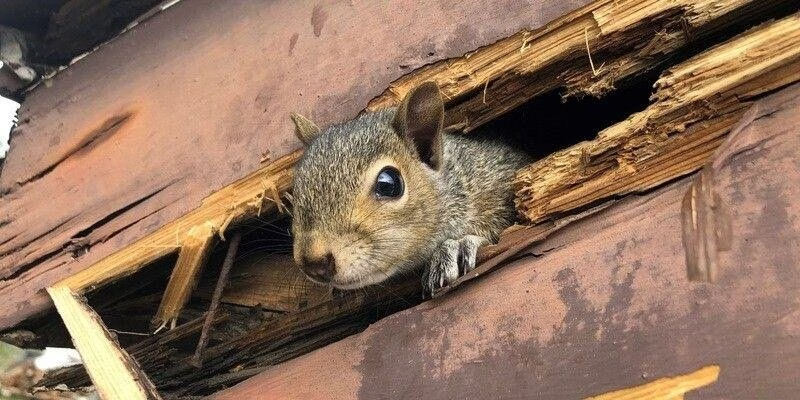
The real risk of doing nothing.
Wildlife in your home is not a problem that resolves on its own. Every day they’re inside, the damage compounds — and the longer you wait, the more expensive the eventual fix becomes. Here’s specifically what’s at stake when squirrel get inside.
Fire risk from chewed wiring
Squirrels gnaw constantly — their incisors never stop growing. Electrical wiring in your attic is one of the most common targets. NFPA data ties a meaningful portion of unexplained residential fires to rodent damage.
Insulation destruction
A pair of squirrels will flatten and contaminate hundreds of square feet of attic insulation in a season. R-value drops dramatically — meaning higher heating and cooling bills.
Structural wood damage
They chew rafters, fascia boards, and soffit returns to enlarge entry holes. What starts as a 1-inch gap becomes a 4-inch hole. Repair costs compound.
Two breeding cycles per year
Squirrels reproduce twice yearly — late winter and late summer. One pair becomes 6+ animals within months if not addressed promptly.
Active during the day
Unlike rodents, squirrels are diurnal. The scratching, scurrying, and rolling-nut sounds happen when you’re home — at all hours of the day.
Dead-animal risk in walls
Poison or DIY trapping in living spaces often leaves squirrels dying in walls or under insulation — leading to weeks of smell and fly issues that require cutting open drywall to resolve.
Signs you have squirrel.
If any of these match what you’re hearing or seeing, call us for a free inspection. We’ll confirm the species and rule out anything else before we ever quote work.
- Scratching, scurrying, or rolling sounds in the attic — especially early morning and late afternoon
- Visible squirrels running along the roofline, gutters, or power lines into the house
- Chewed holes in soffits, gable vents, fascia boards, or roof edges
- Bark, twigs, or shredded insulation appearing in the attic or near eaves
- Acorn or nut shells in the attic, gutters, or near entry points
- A musky smell developing in upstairs rooms or near the attic access
How we actually fix this.
A real solution requires more than catching the animal — you have to seal the access points, repair the damage, and prevent re-entry. Here’s the process we follow for every squirrel job.
Free inspection — interior + exterior
We inspect the attic for nests and damage, then walk the full exterior identifying every entry point. Squirrels often use multiple holes, and missing even one means they’re right back inside. We document everything with photos.
Confirm species & assess for kits
Eastern gray and southern flying squirrels are most common here. If you’re calling in February–April or August–September, there’s a high chance of pups in the nest. We don’t seal anything until we know whether kits are present.
Remove adults via one-way doors
We install one-way exit doors over primary entry points. Adults leave to forage and cannot get back in. If kits are present, we hand-remove them once they’re old enough or with the mother’s cooperation — never sealing them in to die.
Permanent exclusion with steel
Squirrels chew through screen, foam, caulk, and even some woods. We use galvanized hardware cloth (1/4 inch), heavy-gauge ridge vent guards, chimney caps, and steel-reinforced soffit closures. Color-matched for appearance.
Optional: insulation & sanitization
If insulation is contaminated or compressed, we remove it (HEPA-filtered), sanitize the cavity, and blow in fresh insulation to bring R-value back to spec.
Follow-up inspection
Every squirrel exclusion comes with work done right the first time. If they get back in through any sealed area, we come back at no charge and re-do it.
Every squirrel job includes:
No upcharges, no surprise fees. Flat-rate quote up front and full insurance coverage on every exclusion.
- Free attic + exterior inspection
- Species ID + assessment for pups
- Photo documentation of every entry point
- One-way exit doors on primary entries
- Hand removal of kits if present
- Galvanized hardware cloth (1/4 inch) exclusion
- Chimney caps & ridge vent guards (steel)
- Color-matched exterior finishing
- Optional: insulation removal & replacement
- Sanitization of nesting areas
- work done right the first time
- No poison — never
Squirrel — your questions, answered.
Why not just use poison?
We never use poison for squirrels (or for any wildlife) for two reasons. First, poisoned squirrels die in walls and attics — creating weeks of smell and fly issues that require drywall surgery to resolve. Second, poisons cascade up the food chain to pets, raptors, and other non-target wildlife. There is always a better way.
Will they come back?
Not through any area we’ve sealed — that’s what the our commitment is for. But squirrels in your yard will continue to test other parts of the home. Our exclusion is comprehensive: every gap of 1/4 inch or larger on the roofline gets addressed in the same visit, not just the active entry.
How much does this cost?
It varies — every squirrel job is different. The price depends on the number of entry points, the height and complexity of the roof, and whether insulation needs replacement. Rather than guess at a number, we do a free inspection and give you a flat-rate quote up front, with no surprises.
How fast can you come out?
Same-day inspections are usually available for the Memphis metro. Larger jobs or those requiring specialized equipment may need to be scheduled within 24–72 hours.
I hear them but don’t see damage. Is it really squirrels?
Maybe — but it could also be raccoons, rats, or even rodents in walls. Sounds in the attic at dawn and during the day strongly suggest squirrels. Sounds at night more often mean raccoons (heavy) or rats/mice (small scurrying). We’ll confirm during inspection.
What about flying squirrels?
Southern flying squirrels are nocturnal and common in our area. They’re smaller (5–6 inches) and quieter, but they live in colonies of 10–20 in a single attic. They also fit through smaller gaps than gray squirrels. We handle them with the same one-way exclusion approach, just with finer mesh.
Ready to solve this?
Free inspection, flat-rate quote, and work done right the first time. Call us or schedule online — same-day available.