Raccoon
Removal
Raccoons aren’t a nuisance — they’re a structural and biological problem. A 20-pound adult can tear through soffits, lift roof shingles, and rip out attic vents. They carry roundworm, leptospirosis, and (especially in females) a fierce instinct to defend kits with bites. Don’t try to confront one yourself.
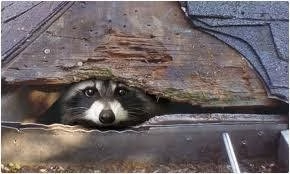
The real risk of doing nothing.
Wildlife in your home is not a problem that resolves on its own. Every day they’re inside, the damage compounds — and the longer you wait, the more expensive the eventual fix becomes. Here’s specifically what’s at stake when raccoon get inside.
Raccoon roundworm (Baylisascaris)
Raccoon feces can contain Baylisascaris procyonis — a roundworm whose eggs are extremely difficult to kill and can cause severe neurological disease in humans if ingested. Latrines (where raccoons repeatedly defecate) must be treated by professionals with PPE.
Leptospirosis & other zoonoses
Raccoon urine carries leptospirosis bacteria, which can sicken humans and pets. Attic insulation contaminated with urine creates ongoing exposure risk.
Aggressive defense of kits
Female raccoons with kits will absolutely bite, scratch, or attack to protect their young. Most raccoon-human conflicts happen when homeowners try DIY removal in spring.
Major structural damage
Raccoons rip soffits, peel shingles, tear gable vents, and shred ductwork. We’ve seen attics where a single family of raccoons caused $8,000+ in damage in a few months.
Chimney trapped kits
Raccoons frequently den in chimneys to birth kits. If you start a fire without checking, you’ll kill the litter — and the smell will haunt your home for weeks. Always inspect a chimney before lighting it in spring.
Pet attacks
Raccoons regularly attack dogs and cats, especially when defending food sources or kits. They carry rabies in our region.
Signs you have raccoon.
If any of these match what you’re hearing or seeing, call us for a free inspection. We’ll confirm the species and rule out anything else before we ever quote work.
- Heavy thumping or rolling sounds in the attic at night (much louder than squirrels)
- Trash cans tipped over or dragged into the yard
- Damage to soffits, gable vents, or shingles — often torn rather than chewed
- Footprints in attic insulation showing 5-toed front paws like small hands
- A pungent, musky odor — distinct from skunk but unmistakable
- Whimpering or chittering sounds (especially in spring — that’s kits)
How we actually fix this.
A real solution requires more than catching the animal — you have to seal the access points, repair the damage, and prevent re-entry. Here’s the process we follow for every raccoon job.
Inspection — assume kits in spring
We inspect the attic, chimney, and full exterior. From February through May, we treat every female raccoon as having kits until proven otherwise. We do not seal anything without confirming whether young are present.
Locate and assess the kits
If kits are present, we locate them — usually using thermal imaging or by sound. Kits are removed by hand and reunited with the mother outside the exclusion using a reunion box. Never sealed in.
One-way door eviction of the adult
We install a heavy-duty one-way exit door over the primary entry. The mother leaves to forage and physically cannot return to the den. Reunion boxes outside encourage her to relocate the kits.
Heavy-duty exclusion
Raccoons require commercial-grade exclusion. We use 16-gauge galvanized steel mesh, lag-bolted into framing — not screwed into shingles. Soffit returns get reinforced. Chimneys get steel raptor-grade caps.
Latrine remediation
Where raccoon latrines exist (corners of attics, beams), the area is treated as a Baylisascaris hazard. We remove contaminated insulation in sealed bags, scorch the roundworm eggs (high-heat treatment), and replace insulation.
Post-job inspection
We come back 60 days after the work to verify no re-entry attempts have succeeded. Every sealed point is backed by our full insurance.
Every raccoon job includes:
No upcharges, no surprise fees. Flat-rate quote up front and full insurance coverage on every exclusion.
- Free inspection with thermal imaging
- Kit detection & humane reunion protocol
- One-way door eviction of adults
- 16-gauge steel mesh exclusion
- Lag-bolt reinforcement on soffits & vents
- Chimney caps (raptor-grade steel)
- Latrine remediation per CDC protocols
- HEPA-filtered insulation removal where needed
- Reunion box for relocating kits
- 60-day post-job re-inspection
- work done right the first time
- Damage assessment & repair coordination
Raccoon — your questions, answered.
There’s a raccoon in my chimney. What do I do?
Do not light a fire. Call us. We’ll come out — same day if possible — and assess whether kits are present. If they are (typical in spring), we do a careful hand-removal and reunion. If it’s just an adult, we install a one-way door and chimney cap. Never try to smoke them out — it kills kits and creates a haunting smell.
I see a raccoon during the day. Is it rabid?
Not necessarily. Healthy raccoons are sometimes active in daylight, especially nursing mothers. But daytime activity combined with disorientation, aggression, or paralysis is a red flag — call animal control immediately and keep pets and children away. We’ll happily come do a follow-up inspection.
How much does raccoon removal cost?
It varies — every raccoon job is different. The price depends on whether kits are involved, how many entry points there are, the complexity of roof access, and whether latrine cleanup or insulation remediation is needed. That’s why we don’t publish flat prices — it would be guessing. After a free inspection we give you a flat-rate quote up front, with no surprises.
Will my homeowner’s insurance cover the damage?
Often yes — for sudden, accidental damage. Most policies don’t cover the wildlife removal itself, but they do cover resulting damage like torn soffits, ruined insulation, and chewed wiring. We’ll document everything in photos for your claim.
Why is the price higher than for squirrels?
Three reasons: raccoons require commercial-grade materials (16-gauge steel, lag bolts) that smaller animals don’t; the exclusion is more labor-intensive (heavier, more roof access, longer install); and latrine remediation, when needed, follows CDC roundworm protocols that require PPE and disposal procedures.
What about repairs to the damage they caused?
We do most of the repairs ourselves as part of the exclusion — soffit replacement, vent screens, shingle work. For larger structural repairs (interior drywall, electrical, ductwork), we’ll coordinate with a contractor and provide full documentation for your insurance claim.
Ready to solve this?
Free inspection, flat-rate quote, and work done right the first time. Call us or schedule online — same-day available.