Roof Rats
& Mice
Roof rats run Memphis rafters and the city’s older neighborhoods are full of them. They breed fast, chew wires, contaminate insulation, and spread hantavirus and leptospirosis. We do permanent exclusion — no poison, no monthly bait routes, no dead rats stinking up your walls.
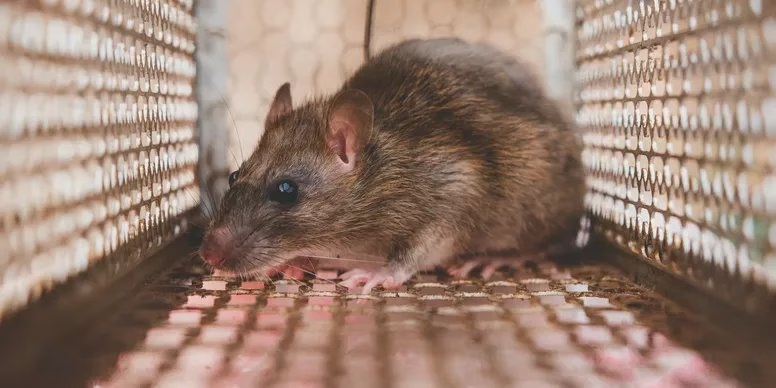
The real risk of doing nothing.
Wildlife in your home is not a problem that resolves on its own. Every day they’re inside, the damage compounds — and the longer you wait, the more expensive the eventual fix becomes. Here’s specifically what’s at stake when rodent get inside.
Hantavirus & leptospirosis
Rodent urine and droppings spread hantavirus pulmonary syndrome (often fatal) and leptospirosis. Both transmit through contaminated dust — meaning vacuuming droppings without proper PPE is itself dangerous.
Wiring fires
Rodents chew constantly to manage their incisors. Electrical wiring in walls and attics is a primary target. NFPA estimates rodents may be responsible for up to 25% of unexplained residential fires.
Food contamination at scale
A single mouse can contaminate 10x more food than it eats — through urine, droppings, and saliva. By the time you see one mouse, the kitchen, pantry, and any open food storage need to be addressed.
Exponential breeding
A breeding pair of mice can produce 30+ offspring per year, and those offspring breed at 8 weeks. The math means small infestations become large infestations within a season.
Roof rats vs Norway rats
Memphis has both — roof rats (climbers, attic dwellers, common in older neighborhoods) and Norway rats (burrowers, basement and crawlspace dwellers). They require different exclusion strategies.
Poisons cause cascading harm
Rodent poison kills the rodent slowly — over days. They die in walls, under floors, in insulation. Their bodies are then eaten by raptors, cats, and dogs, poisoning them too. We never use poison.
Signs you have rodent.
If any of these match what you’re hearing or seeing, call us for a free inspection. We’ll confirm the species and rule out anything else before we ever quote work.
- Droppings along walls, in cabinets, behind appliances, in pantries
- Gnaw marks on baseboards, cabinet edges, food packaging, or wiring
- Scurrying sounds in walls or ceiling at night (mice = lighter; rats = heavier, more rolling)
- Greasy ‘rub marks’ along baseboards or beam edges where rodents travel
- Nests of shredded paper, fabric, or insulation in quiet corners or attics
- Pet food disappearing or being moved overnight
How we actually fix this.
A real solution requires more than catching the animal — you have to seal the access points, repair the damage, and prevent re-entry. Here’s the process we follow for every rodent job.
Full structural inspection
Rodent control without sealing is just farming — they keep coming back. We start with a comprehensive inspection: roof, foundation, attic, crawlspace, garage, and every potential entry point inside and out. We identify the species and the population estimate.
Map and prioritize entry points
We document every gap larger than 1/4 inch (mice) or 1/2 inch (rats) — including weep holes, pipe penetrations, dryer vents, garage door corners, foundation cracks, and roof intersections. We photograph and prioritize them.
Initial population reduction
Inside, we set commercial-grade snap traps in safe locations (away from pets and kids — usually in attics, basements, behind appliances). We monitor and remove caught animals. No poison.
Permanent exclusion seal
This is where most companies fail. We seal every documented entry point with appropriate materials — copper mesh in mortar joints, galvanized hardware cloth on vents, foam-and-mesh combinations for pipe penetrations, brush-strip kits for garage door corners.
Sanitization & contamination removal
Heavily contaminated insulation and nesting material is removed using HEPA-filtered equipment and PPE. Affected areas are sanitized with enzymatic agents that neutralize urine markers (which would otherwise attract new rodents).
Follow-up & quality check
We schedule a 30-day follow-up to verify zero ongoing activity. We don’t leave until the rodent activity is fully resolved.
Every rodent job includes:
No upcharges, no surprise fees. Flat-rate quote up front and full insurance coverage on every exclusion.
- Comprehensive interior + exterior inspection
- Species identification (roof rats, Norway rats, mice)
- Photo map of every entry point
- Commercial snap-trap deployment (pet-safe locations)
- Copper mesh sealing (brick mortar joints)
- Galvanized hardware cloth (vents, weep holes)
- Garage door brush seals
- Dryer vent damper replacement
- Pipe penetration foam-and-mesh seal
- HEPA-filtered contamination removal
- Enzymatic sanitization of nesting areas
- Stand-by-our-work guarantee
Rodent — your questions, answered.
Why won’t you use poison?
Three reasons. First, poisoned rodents die slowly — typically inside walls or insulation — creating weeks of smell and fly issues. Second, poisons cascade up the food chain: when a poisoned rat is eaten by a hawk, a fox, or someone’s outdoor cat, it kills them too. Third, poison doesn’t fix the problem — new rodents enter through the same gaps. Exclusion is the only permanent solution.
Why isn’t traditional pest control enough?
Quarterly pest control treats symptoms. The bait stations catch some rodents, but the entry points stay open — and the population replenishes from outside. The math doesn’t work in the homeowner’s favor. Exclusion-based rodent control is upfront work that solves the problem rather than managing it.
How much does this cost?
It varies — every home is different. The price depends on the size and age of the home, the severity of the infestation, the number of entry points, and whether contamination cleanup is needed. We don’t publish flat prices because it would be guessing. After a free inspection you get a flat-rate quote up front, with no surprises.
How long until I stop hearing them?
Most homeowners report a major reduction within 7–14 days of the trap deployment and exclusion seal. Complete activity cessation typically follows within 30 days. We schedule a follow-up at 30 days to verify.
Do I have to throw out my food?
Anything in cardboard, paper, or open containers that has been accessible to rodents should be discarded — not because of visible droppings necessarily, but because of urine and saliva contamination. Foods in sealed glass, plastic, or metal containers are typically fine. We’ll help you assess during the consult.
What about commercial properties?
We handle commercial rodent work — restaurants, warehouses, multi-family housing, healthcare. The approach is the same (inspect, exclude, monitor, sanitize), but the scale and documentation requirements differ. Ask about our commercial monitoring programs.
Ready to solve this?
Free inspection, flat-rate quote, and work done right the first time. Call us or schedule online — same-day available.