Bat Removal &
Exclusion
Bats are federally and state-protected. Doing this wrong is illegal — and the wrong removal method leaves dead bats in your walls, attic insulation saturated with guano, and a public health hazard. We do it the legal way, the careful way, and we we stand behind every seal.
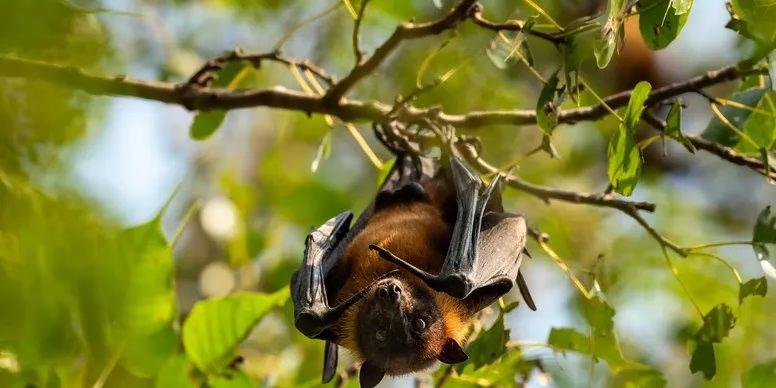
The real risk of doing nothing.
Wildlife in your home is not a problem that resolves on its own. Every day they’re inside, the damage compounds — and the longer you wait, the more expensive the eventual fix becomes. Here’s specifically what’s at stake when bat get inside.
Histoplasmosis spores
Bat guano harbors histoplasmosis — a fungal lung infection that can sicken or hospitalize. Dry guano becomes airborne when disturbed, including through your HVAC.
Rabies exposure risk
Bats are the leading source of rabies exposure in the U.S. Any contact — including a bat found in a bedroom — should be treated as potential exposure and reported to your county health department.
Insulation contamination
A colony can deposit hundreds of pounds of guano in an attic. Once insulation is saturated, it has to be fully removed and replaced — guano cannot be ‘cleaned’ out of fibrous insulation.
Structural damage from acid
Urine and droppings are acidic. Over years, they degrade drywall, eat through paint, stain ceilings, and corrode metal fasteners and ductwork.
Re-entry without proper exclusion
Bats can fit through gaps smaller than a dime (3/8 inch). DIY exclusions almost always miss something — and missing one gap means the colony comes right back.
Illegal if done wrong
Tennessee protects bats during maternity season (typically May 15 – August 15). Sealing a colony in during these months kills flightless pups — and is a violation of state wildlife law.
Signs you have bat.
If any of these match what you’re hearing or seeing, call us for a free inspection. We’ll confirm the species and rule out anything else before we ever quote work.
- Chirping or squeaking sounds at dawn and dusk from the attic, walls, or chimney
- Dark, oily ‘stains’ near gable vents, soffit gaps, or where the roof meets the chimney
- Piles of dark, glittery droppings (different from rodent — sparkles in light because of insect parts)
- Strong ammonia smell on hot days, especially near the attic access
- Visible bats emerging from your roofline at dusk (you can often watch them leave)
- A bat found inside the living space — a sign of a larger colony in the attic
How we actually fix this.
A real solution requires more than catching the animal — you have to seal the access points, repair the damage, and prevent re-entry. Here’s the process we follow for every bat job.
Free thermal & visual inspection
We walk the full exterior with binoculars, then enter the attic with proper PPE and thermal imaging. We identify the species (big brown vs. little brown vs. Mexican free-tail), estimate colony size, and locate every primary and secondary exit point.
Confirm legal timing
Tennessee law (and federal Endangered Species Act for some species) prohibits exclusion during maternity season — typically May 15 to August 15. If you call during that window, we’ll inspect, plan the exclusion, and schedule the work for the legal date.
Install one-way exclusion devices
Once outside the maternity window, we install one-way exit devices on every primary exit. Bats leave at dusk to feed and physically cannot get back in. We monitor for 5–10 nights to confirm full evacuation.
Seal every gap to 3/8 inch
After confirmed evacuation, we permanently seal every potential re-entry point — including gable vents (with hardware cloth), ridge vents, soffit gaps, chimney junctions, and pipe penetrations. Materials are color-matched.
Guano remediation & sanitization
If the colony was sizable, we remove contaminated insulation, vacuum guano with HEPA-filtered equipment, and apply an enzymatic sanitizer. We document everything with photos for your records.
backed by our full insurance
Every bat exclusion comes with a written work done right the first time. If any sealed area fails, we come back and re-do it at no charge.
Every bat job includes:
No upcharges, no surprise fees. Flat-rate quote up front and full insurance coverage on every exclusion.
- Free thermal & visual inspection
- Species ID and colony assessment
- TWRA-compliant scheduling
- One-way exclusion devices on every primary exit
- Full perimeter seal (gable vents, soffits, ridge, chimney junction)
- Galvanized steel hardware cloth (1/4 inch)
- Color-matched exterior sealants
- Optional: guano cleanup & insulation replacement
- HEPA-filtered remediation
- Written backed by our full insurance
- Photo documentation of every sealed point
- No subcontractors — our crew only
Bat — your questions, answered.
Why can’t I just have you do this in June?
Tennessee law protects bats during maternity season (roughly May 15 – August 15). During this window, flightless pups are in the roost. Sealing the colony out leaves the pups to die in your attic — which is illegal under state law and creates a worse problem for you. We inspect any time of year, but we schedule the exclusion outside the maternity window. We’ll be honest with you about timing.
Is one bat in my house an emergency?
Treat it as one. Bats are the leading source of rabies exposure in the U.S. If a bat is found in a bedroom — especially with someone sleeping, a child, or anyone unable to confirm contact — contact your county health department about post-exposure prophylaxis. Then call us to inspect for a colony. A bat in the living space almost always means a colony in the attic.
How much does bat exclusion cost?
It varies — every bat job is different. The price depends on roof complexity, the size of the colony, the number of access points, and whether guano remediation is needed. Bat work is also the most regulated wildlife job in Tennessee, which affects timing. We provide a flat-rate written quote after the inspection — no hourly billing, no surprises.
Will the guano need to be removed?
It depends on volume and location. A small colony (under a dozen bats, less than a year) often produces guano that can be left in place under existing insulation. Larger or longer-established colonies typically require removal of saturated insulation, HEPA vacuuming, and enzymatic sanitization. We’ll show you what we find and give you both options.
Will sealing scare the bats away?
No. Bats are loyal to roost sites and will work hard to find any unsealed gap. That’s why we use one-way exclusion devices instead of just sealing — and why DIY exclusions usually fail. We seal after confirmed evacuation, not before.
How long does the whole process take?
From inspection to fully sealed: typically 2–3 weeks. The one-way devices need 5–10 nights of monitoring to confirm evacuation, then the perimeter seal happens in 1–2 days. If guano remediation is needed, add 1–2 more days.
Ready to solve this?
Free inspection, flat-rate quote, and work done right the first time. Call us or schedule online — same-day available.